Why the Pose Fails Before the Weight Does in Sculpt
Quick Answer: In sculpt, the weight is rarely the limiting factor. The base position - the squat, the lunge, the plank - is under continuous isometric load with no rest, and postural stabilisers fatigue on a much faster clock than the small muscles moving the dumbbell. So the pose degrades first: the knees drift, the ribs flare, the hips sink. That is a signal to hold a shallower base position, not to drop the weight. Fix the base and the same dumbbells suddenly feel manageable.
The two-kilo weights are almost embarrassing on the rack.
And on the third round of chair-pose curls your legs are shaking and your form has visibly gone.

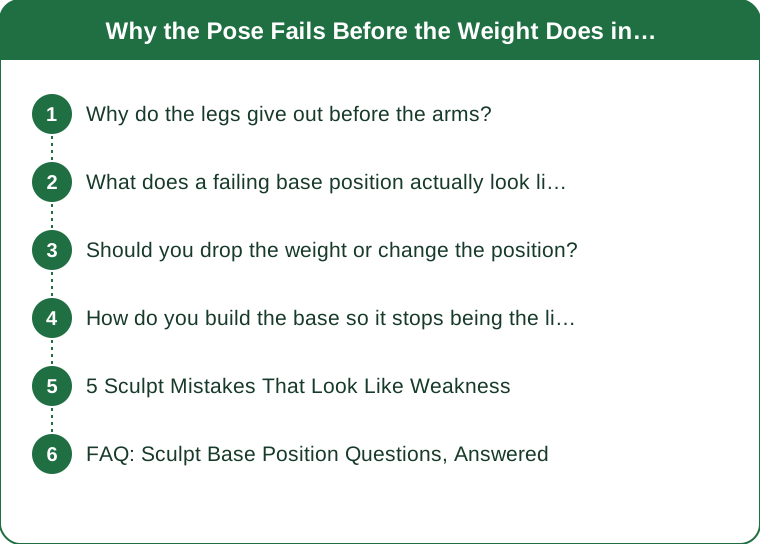
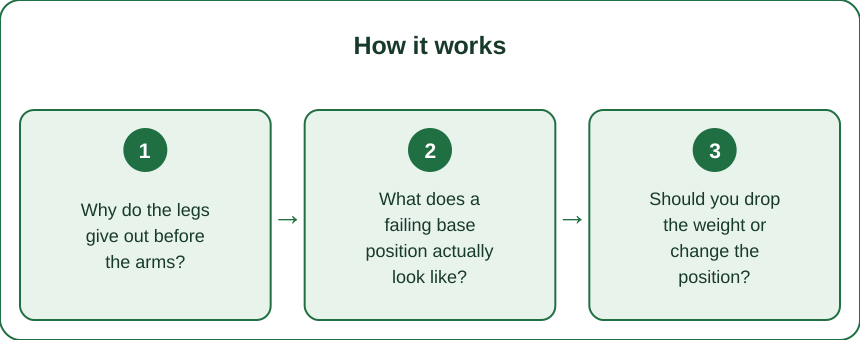
Why do the legs give out before the arms?
The base position is a continuous isometric hold with no lowering phase and no rest, and isometric holds fatigue much faster than the equivalent dynamic work.
Postural muscles are working the entire class, not just during the arm sets, so their fatigue accumulates across the whole session rather than resetting between exercises.
The arm movement is small and intermittent, so the muscles moving the weight get micro-recoveries the legs never get.
Blood flow is restricted in a sustained hold, which accelerates local fatigue independently of how hard the muscle is working.
Heat compounds it, since sculpt rooms are warm and elevated core temperature raises perceived effort and speeds fatigue.
And the base position gets no attention because you are watching the dumbbells, which is exactly why it degrades unnoticed.
What does a failing base position actually look like?
Knees drifting inward in chair or lunge, which is usually the first visible sign and the one most worth catching.
Ribs flaring and the lower back arching, which means the core has stopped managing the load and the spine is taking it.
Hips sinking or piking in plank, which is the same story in a horizontal position.
Weight shifting onto the toes in a squat, because the glutes have stopped contributing and the quads are taking everything.
Shoulders creeping toward the ears, which is the upper-body equivalent and the source of a lot of post-class neck tension.
And breath-holding, which is the most reliable single indicator that you are past what the position can support.
Should you drop the weight or change the position?
Change the position first, almost always. A shallower chair pose or a shorter lunge stance restores the base without giving up the arm work.
Dropping the weight leaves you in the same failing position with less arm stimulus, which is the wrong trade.
Come up two inches in chair rather than abandoning it, which is usually all it takes.
Take a knee down in lunges for a round if the standing version has gone, and rejoin the standing version on the next one.
Drop to the knees in plank-based work while keeping the arm movement exactly as it is.
And only drop the weight if the arm movement itself has lost control, which in a well-chosen sculpt weight is uncommon.

How do you build the base so it stops being the limit?
Train unweighted isometric holds separately, since wall sits and plank holds build exactly the endurance the class demands and cost nothing.
Add a heavy compound lift session on a different day, which builds the strength that makes the sculpt base position feel like a smaller fraction of your capacity.
Practise the base positions without weights so you know what they feel like when they are correct.
Work on ankle mobility, since a limited ankle forces a forward-leaning chair pose that loads the quads and back rather than the whole chain.
Build glute strength specifically, because a base position that fails into the quads is usually a glute contribution problem.
And accept that this takes weeks, not sessions - isometric endurance improves steadily but not quickly.
5 Sculpt Mistakes That Look Like Weakness
1. Choosing weights by what your arms can lift. The relevant question is what your arms can lift while your legs hold a squat for 60 seconds in a warm room. Those are very different numbers, which is why sculpt weights are lighter than people expect and why a strong lifter can struggle in their first class.
2. Holding the deepest version of the base position from the start. A chair pose you can only hold for 20 seconds means the last 40 seconds of the set are done badly. Two inches higher and holding it for the whole set is more work, not less.
3. Watching the dumbbells in the mirror. Attention goes where you look, and the arm movement is the part that is going fine. Watching the knees and the ribs catches the failure that matters.
4. Breathing with the arm movement instead of the pose. In sculpt the base position is the demanding part, so breath should stay steady and continuous rather than being timed to the small upper-body reps. Breath-holding is where the shaking gets worse fast.
5. Treating the shaking as the goal. Shaking is a sign that motor units are cycling under fatigue, which is normal - but shaking with a collapsed position is just practising a collapsed position. Shaking while holding a clean shallower version is the useful version.
And the bonus: taking the same weights every week. If the base position is holding fine for the whole class, that is the signal to go up. Most people keep the same two dumbbells for a year and wonder why the class stopped changing anything.
FAQ: Sculpt Base Position Questions, Answered
What weight should I actually use?
Heavy enough that the last two reps of an arm set are hard, light enough that your base position survives the whole round. If the pose fails first, the pose is the problem, not the weight.
Is shaking bad?
No, shaking under load is normal fatigue. Shaking with a collapsed position is the version to fix, by making the base shallower.
Why am I sorer after sculpt than after lifting?
Long time under tension, high total volume, warm room and a lot of unaccustomed isometric work. It is a different stimulus, not a harder one.
Should I go lighter and do more reps?
Usually not. In sculpt the volume is already high, and going lighter mostly reduces the arm stimulus without helping the base position.
How do I improve chair pose endurance?
Unweighted wall sits outside class, ankle mobility work, and heavy lower-body strength training on a separate day.
Is it OK to modify every round?
Yes. Modifying to keep the position correct is the whole skill. The alternative is practising a degraded pattern for 50 minutes.
TL;DR:
- The base position is a continuous isometric hold with no rest, so it fatigues long before the small muscles moving the dumbbell.
- Knees drifting in, ribs flaring, hips sinking and breath-holding are the signs it has gone.
- Change the position before you change the weight: two inches higher in chair beats dropping to lighter dumbbells.
- Build the base separately with wall sits, planks, ankle mobility and heavy lower-body work on other days.
- If the base holds cleanly all class, that is your signal to increase the weight.
The dumbbells were never the hard part. The thing holding you up was.
See It in Motion
Seen here: High Waist Embossed Yoga Leggings with Side Pockets — shop it on bubblelime.com
Keep Reading
This article is for general informational and styling purposes only. Fit, sizing, and product availability may vary.