Why One Side Fatigues First in Yoga Sculpt
Quick Answer: Side-to-side differences of roughly 10 percent are normal and nearly universal — they come from handedness, daily habits, and the order you train, not usually from a problem. In yoga sculpt the gap looks larger because you hold positions to fatigue and the weaker side reaches it first. Work the weaker side first, match the stronger side to what the weaker one can do, and only investigate further if the gap exceeds about 15 percent or comes with pain.
Everything is fine through the warm-up. Then the second round of the arm series arrives and your left side is done while your right is asking for more.
Here is where the gap comes from and what to do about it during the class you are actually in.

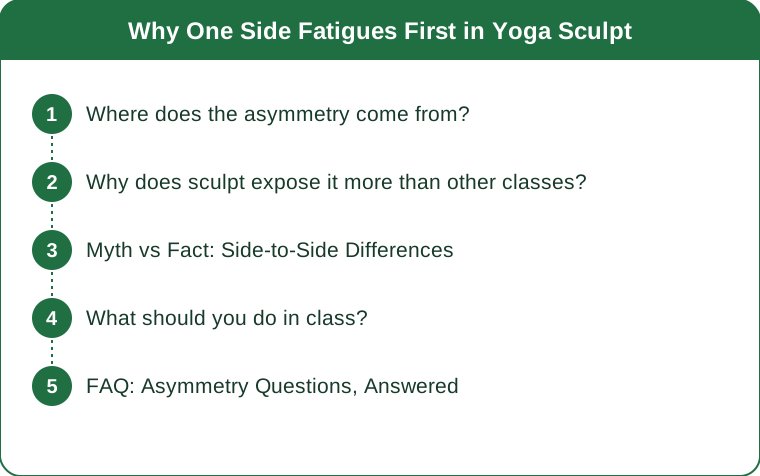
Where does the asymmetry come from?
Several sources, and most of them are entirely ordinary.
Handedness. Limb dominance produces measurable differences in strength and, more importantly here, in motor control and endurance. The dominant side is better at recruiting efficiently, which shows up most in the sustained, repetitive work sculpt is built on.
Daily loading habits. Which shoulder carries the bag, which arm holds the child, which side you lean on at a desk. These accumulate over years and they are usually a bigger factor than anything you do in a gym.
Order of training. In almost every class, one side goes first. That side is fresher, sets the standard, and the second side inherits the fatigue. If the sequence always starts right, the left will always look weaker than it is.
Breathing and rotation patterns. Habitual rotation preferences through the ribcage and pelvis change how load distributes in standing and plank positions, particularly in a class that alternates between them.
Old injuries. Even a long-resolved ankle sprain or shoulder issue leaves altered recruitment patterns, sometimes for years.
What this means practically: a gap is not evidence of dysfunction. A gap that is growing, painful, or over about 15 percent is worth attention. A stable 8 percent difference is a description of a normal person.
Why does sculpt expose it more than other classes?
Because of what the format does, not because you are more asymmetric on those days.
- You work to fatigue. Flow yoga rarely takes you to the point where a limb refuses. Sculpt does, repeatedly, and failure points are where differences become visible.
- High reps with light weight. Endurance differences between sides are typically larger than maximal strength differences, and light-weight high-rep work is an endurance test.
- Unilateral positions with a stability demand. A single-arm movement in a lunge asks the shoulder and the standing leg to cooperate. Two systems with slight asymmetries compound.
- Heat. A heated room raises heart rate and perceived effort, which brings the fatigue point closer and makes the weaker side’s limit arrive sooner in the class.
- You compare directly. Twenty reps right, then twenty reps left, back to back. It is the most direct comparison in any fitness format, which is exactly why sculpt practitioners notice this and runners do not.
The heat point is worth sitting with. If the gap seems worse than it used to be and the studio just turned the heat back up for autumn, that is a plausible explanation on its own.

Myth vs Fact: Side-to-Side Differences
Myth: A strength difference means something is wrong. Fact: Bilateral differences of around 10 percent are common in people with no history of injury at all. Perfect symmetry is not a thing that exists in trained or untrained populations.
Myth: You should train the weak side extra to catch it up. Fact: Adding volume to one side works better than most people expect, but the more reliable approach is starting with the weaker side and matching the stronger side to it. Extra unilateral volume without that ordering change tends to preserve the gap because the strong side keeps setting a higher ceiling.
Myth: The weaker side needs lighter weight. Fact: If it needs a lighter weight to complete the same reps with the same form, that is exactly what it should have. Using the same dumbbell on both sides and letting form collapse on one is how you train the compensation rather than the muscle.
Myth: The gap will close in a few weeks. Fact: Meaningful change in a long-standing asymmetry takes months, and some of it reflects daily habits that training does not touch. Closing it entirely is often not the right goal.
Myth: It is always the non-dominant side. Fact: Frequently, but not always. Overhead athletes often have a stronger non-dominant stabiliser pattern, and old injuries can flip the expected direction. Notice which side yours actually is rather than assuming.
What should you do in class?
Adjustments that work inside a group class without disrupting anything:
Start with the weaker side whenever you have the choice. In any sequence where the instructor does not specify, lead with the side that fatigues first. It gets the fresh version of you.
Match reps to the weaker side. If left manages twelve with good form and right could do sixteen, do twelve on both. The extra four on the strong side maintains the gap and contributes very little.
Carry two weight options if the studio allows. A lighter dumbbell for the weaker side lets both sides work at the same relative effort, which is the actual training variable.
Watch for the compensations rather than the count. On the weaker side, look for the shoulder hiking toward the ear, the ribs flaring, the torso tilting, the hip dropping. Those appearing is the end of the set, whatever the instructor is counting.
Take the break on the weaker side. Sitting out four reps on the side that has lost form is a better decision than completing them badly, and nobody in the room is watching.
Outside class: if you want to close the gap, two short unilateral sessions a week — single-arm rows, single-leg work, carries on the weaker side — do more than anything you can change inside a sculpt class.
If one side is painful rather than weak, or if weakness appeared suddenly, that is a matter for a doctor or physiotherapist rather than a training adjustment. This is general information, not medical advice.
FAQ: Asymmetry Questions, Answered
How big a difference is too big?
A commonly used threshold in return-to-sport testing is around 10 to 15 percent, above which the difference is treated as meaningful. Below that, it is generally considered within normal variation. Pain or a sudden change matters more than the percentage either way.
Should I use different weights for each side?
Yes, if the studio has them and it lets both sides work at similar relative effort. This is standard practice in strength training and there is no reason it should not apply in a sculpt class.
Does it ever fully even out?
Usually it narrows rather than disappears. Since a large part of the cause is how you use your body outside training, complete symmetry would require changing that too — and it is rarely worth pursuing for its own sake.
Why does the gap feel bigger in a hot class?
Heat raises heart rate and perceived exertion and brings the fatigue point forward, so the weaker side hits its limit earlier and the difference between sides gets more class time to display itself. Same asymmetry, more visible conditions.
TL;DR:
- Around 10 percent side-to-side difference is normal and comes mostly from handedness and daily habits.
- Sculpt exposes it because it trains to fatigue with high reps and compares sides back to back.
- Lead with the weaker side, match the stronger side’s reps to it, and use a lighter weight on the weaker side if needed.
- Investigate if the gap exceeds roughly 15 percent, appears suddenly, or comes with pain.
Switch which side you start on. It is the smallest change on this list and it addresses the most likely cause.
See It in Motion
Seen here: High Waist 8” Yoga Shorts — shop similar styles on bubblelime.com
Keep Reading
This article is for general informational and styling purposes only. Fit, sizing, and product availability may vary.