You Are Not Losing Yoga Sculpt in the Holds - You Are Losing It in the Transitions
Quick Answer: In a typical sculpt class, transitions account for 20-30% of the total class time and almost none of the training stimulus, because most people drop the weights, stand up, and reset between sequences. Keeping the weights in your hands and moving through transitions deliberately converts that time back into work - and it is the single largest available upgrade to the class.
You are working hard in the holds. Your arms shake, the instructor cues one more, and you are genuinely in it.
Then the sequence ends and there are twelve seconds of resetting, water, weight-swapping and finding your spot again. Then another sequence.
Do that thirty times in an hour and you have handed back a meaningful chunk of the class - and it is the chunk nobody thinks about because it does not feel like part of the workout.

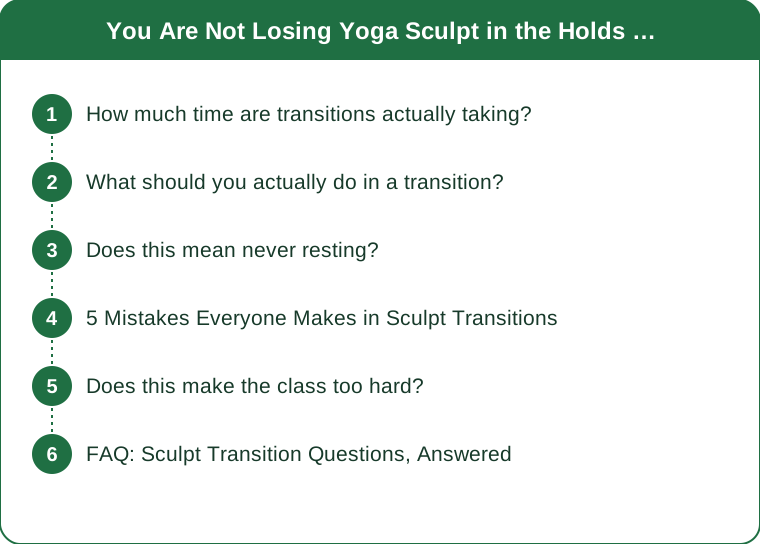
How much time are transitions actually taking?
More than it seems from inside the class. A 60-minute sculpt class typically contains 25-35 discrete sequences or pose changes. At 10-20 seconds of reset each, that is 6-12 minutes of the class.
That time is not wasted in a strict sense - some recovery is necessary, and the instructor needs to cue. But there is a large difference between a controlled transition with the weights still in your hands and a full reset where you put everything down, stand up, and disengage.
The second kind does three things: the muscles fully unload, your heart rate drops out of the working range, and your attention resets, which means the first two reps of the next sequence go into re-finding the position rather than into work.
The fix is not moving faster or resting less. It is changing what you do with the time you were already spending.
What should you actually do in a transition?
Four options, in rough order of how much they add:
1. Keep the weights in your hands. The simplest and the biggest. Holding light dumbbells through a transition maintains grip, shoulder, and postural engagement continuously. Over an hour that is a substantial addition to total time under tension.
2. Move through the transition rather than standing up. Going from a lunge to the next position through a low, controlled path keeps the legs loaded. Standing all the way up and re-lowering is a reset.
3. Stay in the shape one extra breath. When the instructor cues the change, finish your current rep with control instead of abandoning it. Most people release the last rep the moment they hear the next instruction.
4. Keep the core engaged. The easiest thing to lose and the least visible. Standing in a slouch between sequences is where the core work of the previous three minutes gets partly given back.
None of these require working harder. They require not switching off.
Does this mean never resting?
No - and this is worth being clear about, because sculpt is already a high-fatigue format in a heated room.
Genuine rest is legitimate and necessary. The distinction is between deliberate rest and default disengagement.
Deliberate rest: you decide you need it, you put the weights down, you breathe, you rejoin. That is a good decision and it is how you get through the second half of a class with form intact.
Default disengagement: every transition becomes a reset because that is the habit, including the ones where you had plenty left.
A reasonable target is to be engaged through roughly 70-80% of transitions and to genuinely rest through the rest, chosen on purpose. Trying for 100% is how form degrades and how the last fifteen minutes get worse.
And take the water. Dehydration in a heated class is not the place to be tough.

5 Mistakes Everyone Makes in Sculpt Transitions
1. Swapping weights mid-class more than once. Every swap is a full reset plus the walk to the rack. Pick one set you can hold for the whole class, sized for the hardest sequence rather than the easiest.
2. Fixing the mat and towel every time. Set up once with a towel you will not need to adjust. The repeated fussing is pure time.
3. Checking the clock at every transition. It breaks attention completely and it makes the class feel longer, which is the opposite of what you wanted.
4. Dropping the weights to the mat instead of setting them down. Beyond the noise, it builds the habit of a full disengagement. Setting them down deliberately keeps you in the session.
5. Treating the last two sequences as a cooldown. The end of class is when the accumulated fatigue makes the work most productive. It is also when transitions get longest.
Does this make the class too hard?
It makes it harder, which is usually the point - people who plateau in sculpt have almost always plateaued because the class stopped being a stimulus, not because the movements stopped working.
But adjust for it. If you are going to close the transitions, consider dropping the weights by 2-3 lbs for the first two or three classes. Total work goes up even with lighter dumbbells, because the time under tension increases significantly.
The honest signal to watch: if your form in the last fifteen minutes gets noticeably worse after making this change, you have overshot. Back off the engagement on alternating transitions rather than going back to full resets.
This is general information, not medical advice. In a heated class, dizziness, nausea, or unusual breathlessness means stop and rest regardless of what the sequence is doing.
FAQ: Sculpt Transition Questions, Answered
Will the instructor mind?
No - staying engaged is not disruptive and most instructors will notice it approvingly. The exception is if you are moving ahead of the cues, which does disrupt the class. Stay in the timing, just stay loaded.
Does this apply to home sculpt workouts too?
More, actually. Home sessions have longer transitions because nobody is pacing you, and video sessions often build in more reset time than a live class does.
How much difference does it really make?
Realistically, closing half your transitions adds somewhere around 4-6 minutes of loaded time to a 60-minute class. That is roughly a 10% increase in stimulus for zero additional class time - which is a better return than almost any other adjustment available.
TL;DR:
- Transitions are 20-30% of a sculpt class and produce almost no stimulus by default.
- Keep the weights in your hands, move low rather than standing up, finish the last rep, keep the core on.
- Deliberate rest is fine; default disengagement is the thing to fix. Target engagement through 70-80% of transitions.
- Pick one weight for the whole class - every swap is a full reset.
- Drop 2-3 lbs for the first few classes after making this change, because total work goes up.
The holds were never the problem. The class is already the right length - it just has six to twelve minutes hidden inside it that you have been giving back without noticing.
See It in Motion
Keep Reading
This article is for general informational and styling purposes only. Fit, sizing, and product availability may vary.