Why the Music Tempo in Yoga Sculpt Class Changes How Hard You Actually Work
Quick Answer: Faster tempo music tends to speed up rep pace and raise perceived effort, while slower tempo tracks during holds actually deepen time-under-tension — both matter for results, but they train different things, and matching your own pace to the room’s tempo instead of the music can protect your form.
Same instructor, same sequence, different playlist — and the class feels completely different by the end. It’s not just mood. Tempo genuinely changes how your body executes the same movements.
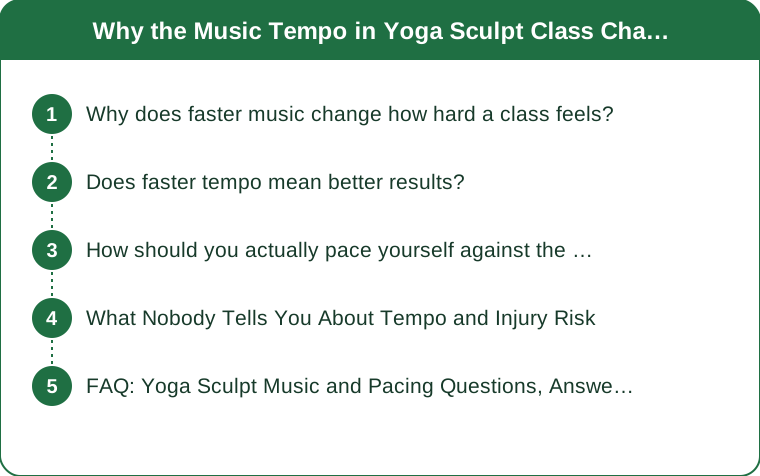
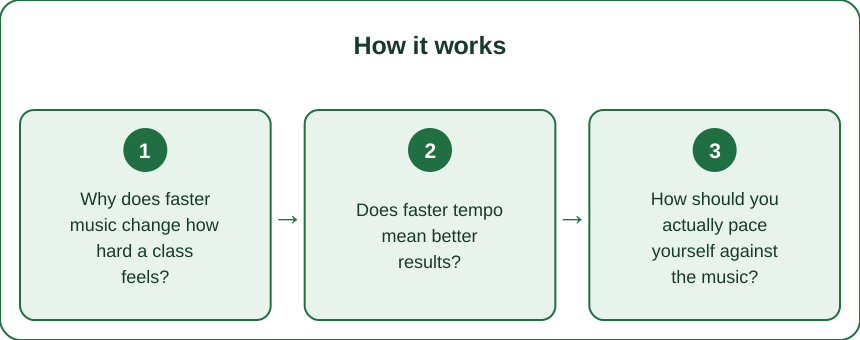
Why does faster music change how hard a class feels?
Music tempo has a well-documented effect on perceived exertion and movement cadence — faster BPM tends to unconsciously speed up rep tempo, which raises heart rate and burn sensation even when the actual exercise selection hasn’t changed.
This is why the exact same squat sequence can feel like a completely different workout depending on whether the track behind it is 95 BPM or 128 BPM.
Does faster tempo mean better results?
Not automatically. Speeding up reps to match a fast track often shortens time under tension, which can reduce the muscular loading that sculpt classes are actually built around. A slower, controlled pace during isometric holds — even with upbeat music playing — usually produces more of the burn instructors are cueing for.
The goal is control matched to the movement, not blind sync with the beat.
How should you actually pace yourself against the music?
Use tempo for transitions, not for holds. Let faster tracks carry you through cardio bursts or quick transitions between positions, but deliberately slow your own count during static holds like a squat pulse or plank, regardless of what the track is doing.
Instructors who understand this often build playlists with faster songs for cardio blocks and slower ones for strength holds — but even without that structure, you can self-pace by ignoring the beat during isometric work.
What Nobody Tells You About Tempo and Injury Risk
Rushing reps to match a fast song is one of the more common ways form breaks down mid-class — knees drifting inward, rounding through the low back, or losing core brace, all because the movement is trying to keep up with a tempo it wasn’t designed for.
If a class consistently feels rushed rather than challenging, that’s a cue to consciously slow your own pace rather than assuming the intensity itself is the problem.
FAQ: Yoga Sculpt Music and Pacing Questions, Answered
Should instructors match music tempo to the workout phase?
Many do intentionally — faster tracks for cardio intervals, slower ones for holds — though not every class is programmed this way, so self-pacing is a useful skill regardless.
Can slow music make a class feel too easy?
It can lower perceived intensity even at the same actual effort level, which is worth knowing if you’re using how a class ‘feels’ to judge whether you pushed hard enough.
Is it bad form to intentionally go slower than the music during holds?
No — deliberately slowing your pace during isometric holds, regardless of the track, generally improves muscular loading rather than reducing it.
TL;DR:
- Faster tempo music raises perceived effort and can unconsciously speed up rep pace
- Speeding reps to match music often shortens time-under-tension, reducing the actual burn
- Use fast tracks for cardio transitions, self-pace slower during static holds regardless of the beat
- A rushed-feeling class is a cue to slow your own pace, not a sign the workout is simply harder
Tempo shapes the workout more than most people notice — pacing yourself deliberately gets you more out of the same class.
See It in Motion
Seen here: Racerback Tank Top - White — shop similar styles on bubblelime.com
Keep Reading
This article is for general informational and styling purposes only. Fit, sizing, and product availability may vary.