Hand Weights or Wrist Weights for Yoga Sculpt?
Quick Answer: Hand weights let you change the load position through a movement and load the muscles you are trying to work; wrist weights keep the load fixed at the forearm, free your hands for floor poses, and put a constant long lever on the shoulder. Hand weights are better for strength work in a sculpt class; wrist weights suit flow-heavy formats where you need your palms on the mat. Wrist weights are not a lighter option — a one kilo wrist weight held at arm’s length is a substantial shoulder load.
The difference is leverage, not weight.
We have covered weight selection, breath holding with weights and grip control when sweaty. This is the equipment decision underneath them.
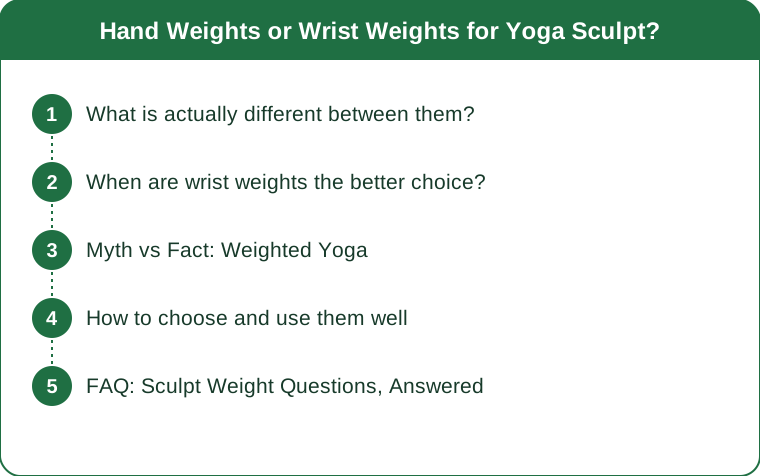
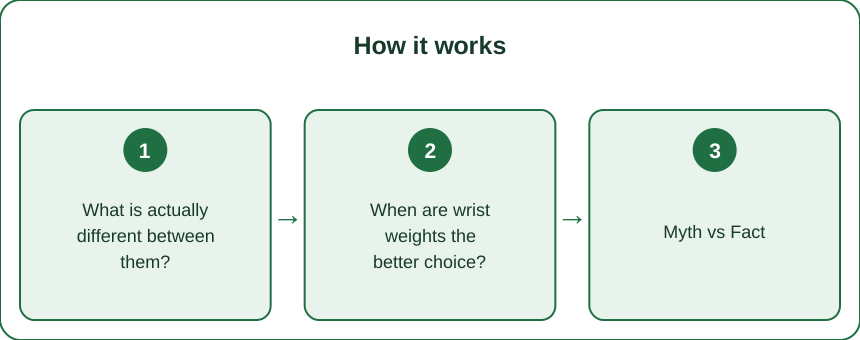
What is actually different between them?
Where the load sits relative to the joints doing the work.
Hand weights load the end of the lever. Held in the hand, the weight sits at the furthest point from the shoulder, which maximises the moment arm.
Wrist weights sit a little closer. Not much — the wrist is nearly as far from the shoulder as the hand — so the reduction in shoulder torque is smaller than people assume.
Hand weights can be repositioned mid-movement. You can bring them close for one exercise and extend for another, which changes the difficulty without changing the weight.
Wrist weights cannot. The load stays fixed at the forearm regardless of what you are doing, which means every arm position carries it.
Which is the key trade-off. Wrist weights are always on, including during the poses where you would have put the weights down.
And grip is the other major difference. Hand weights require sustained grip, which is genuinely tiring in a hot room with sweaty hands, and which wrist weights eliminate entirely.
When are wrist weights the better choice?
In flow-based formats where your hands need to be free.
Any sequence with chaturanga, downward dog or plank. You cannot hold dumbbells through these, so hand weights mean putting them down and picking them up repeatedly.
Continuous flow classes where stopping to collect weights breaks the rhythm and costs time.
Anyone with grip limitations — arthritis, a hand injury, or simply small hands and a slippery hot-room dumbbell.
Movements where you want a constant low-level load rather than a targeted one, such as arm-heavy flow sequences.
Home practice with limited equipment, where one pair of wrist weights covers more of a class than one pair of dumbbells.
And they are genuinely safer in some respects. A dropped dumbbell in a crowded class is a real hazard, and wrist weights cannot be dropped.

Myth vs Fact: Weighted Yoga
Myth: Wrist weights are the easier option. Fact: They are the always-on option. A one kilo wrist weight through an entire arm-heavy flow can be more total work than three kilo dumbbells used for a few discrete exercises, because there is no rest.
Myth: Wrist weights are gentler on the shoulders. Fact: The wrist is only slightly closer to the shoulder than the hand, so the leverage is nearly identical. What changes is that the load is present in every position, including overhead ones where the shoulder is least stable.
Myth: Heavier is better for tone. Fact: Sculpt classes generally work at high repetition and moderate load. Going too heavy degrades the movement quality and shifts the work to larger compensating muscles, which is the opposite of the intent.
Myth: You can build meaningful strength with either in a sculpt class. Fact: You can build endurance and some strength, particularly if you are newer to resistance training. For continued strength progress you need progressive overload, and a class with fixed light weights will plateau.
Myth: Ankle weights and wrist weights are interchangeable. Fact: They are not, and wearing ankle weights on the wrists is a poor fit that slides. More importantly, ankle weights in standing balance poses change the load on the knee considerably and are worth more caution.
Myth: If your shoulders burn, it is working. Fact: Burning in the front of the shoulder during sustained arm-raised work is often the smaller stabilisers fatiguing, not the muscles you are targeting. That is the point to lower the arms, not to push through.
How to choose and use them well
Six practical rules.
Match the tool to the class format. Discrete strength segments mean hand weights; continuous flow with floor poses means wrist weights.
Start lighter than you think with wrist weights. Half a kilo to one kilo per wrist is plenty for a full class. Two kilos through an hour of arm-heavy flow is more than most people expect.
Use both if the class allows. Wrist weights for the flow sections, dumbbells picked up for the discrete strength blocks. This is what most experienced sculpt regulars end up doing.
Check the fastening every few weeks. Hook-and-loop closures clog with lint and sweat and lose grip, and a wrist weight that slides down onto the hand during a plank is genuinely annoying and slightly risky.
Lower the arms when form degrades, regardless of what the class is doing. Shoulder position is the thing to protect, and no amount of extra repetitions is worth losing it.
And wash them. Wrist weights sit against skin in a hot room and are rarely cleaned. Most can be wiped or hand washed, and they need it more than dumbbells do.
One caution: if you have any history of shoulder impingement or rotator cuff problems, sustained arm-raised work with wrist weights is worth discussing with a physiotherapist before adding it. This is general information, not medical advice.
FAQ: Sculpt Weight Questions, Answered
Are wrist weights easier than hand weights?
Not necessarily. They are lighter per unit but always present, including during poses where you would normally set dumbbells down. The leverage on the shoulder is nearly identical, since the wrist sits only slightly closer to the shoulder than the hand does.
How heavy should wrist weights be for yoga sculpt?
Half a kilo to one kilo per wrist for most people. That sounds trivial and produces substantial cumulative work across an hour of arm-heavy flow, because there is no point in the class where the load comes off.
Can I use ankle weights on my wrists?
It is not ideal. They are sized for a different limb and tend to slide, which is distracting and slightly risky in plank-based poses. Purpose-made wrist weights are inexpensive and fit properly, which matters more than it sounds.
TL;DR:
- The difference is leverage and continuity, not weight. Wrist weights are always on.
- Hand weights let you reposition the load mid-movement and target specific muscles.
- Wrist weights free your palms for floor poses and eliminate grip fatigue in a hot room.
- Start at half a kilo to one kilo per wrist — an hour with no rest adds up faster than you expect.
Most experienced sculpt regulars use both: wrist weights for the flow, dumbbells for the strength blocks.
See It in Motion
Seen here: Super High Waist Embossed Yoga Leggings with Inner Pocket — shop it on bubblelime.com
Keep Reading
This article is for general informational and styling purposes only. Fit, sizing, and product availability may vary.