Why You Hold Your Breath in Yoga Sculpt — and What to Do Instead
Quick Answer: You hold your breath in sculpt because two competing instructions collide — yoga asks for a continuous breath tied to movement, while lifting instinctively triggers a brief bracing hold. Under fatigue in a heated room, bracing usually wins and you end up in a partial breath hold for whole sequences. Fix it by choosing a simple rule and repeating it: exhale on the effort, inhale on the return, count the reps out loud in your head on the exhale, and drop the weight one size when you notice the breath disappearing.
Halfway through the second round of chair-pose curls you realize you have not breathed in about eight seconds.

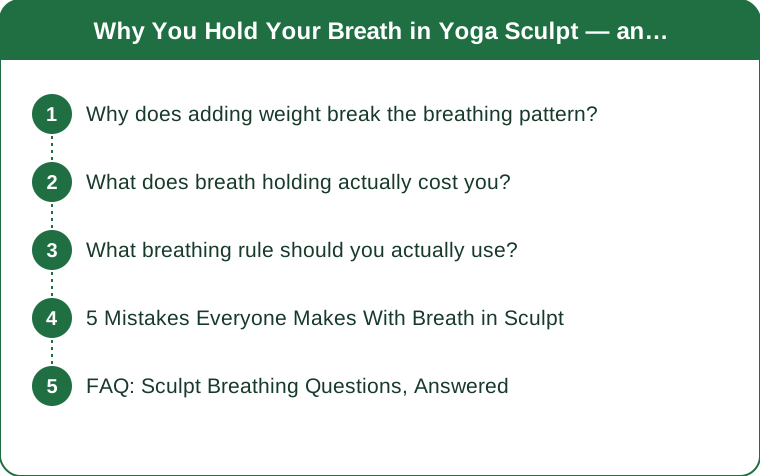
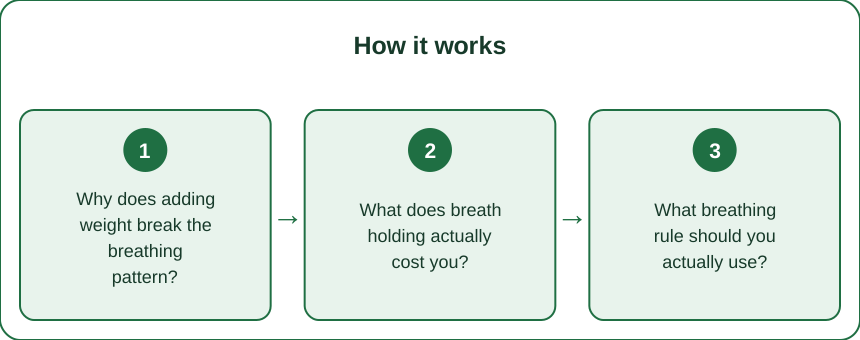
Why does adding weight break the breathing pattern?
Because the two disciplines have genuinely different default instructions and sculpt puts them in the same minute.
In a standard vinyasa flow, breath leads movement. One breath, one movement, continuously, with no holding at any point. The breath is the metronome.
In strength training, the body’s automatic response to load is the Valsalva-like brace — a brief closure and increase in intra-abdominal pressure that stabilizes the spine. It is not a mistake in a heavy lift; it is a genuine stabilizing mechanism.
The problem is that this reflex fires even at light loads, and in a flowing sequence where each rep is not clearly separated, the brief brace never releases. You end up holding through three or four reps instead of one.
Add a heated room and everything intensifies. Higher heart rate, higher respiratory demand, more perceived effort, and less spare attention for something as background as breathing. This is why sculpt specifically produces this problem far more than either yoga or lifting alone.
What does breath holding actually cost you?
More than most people assume for something that lasts a few seconds.
Blood pressure spikes and then dips sharply on release. In a hot room, where blood is already directed toward the skin for cooling, that dip is what produces the lightheaded feeling people get standing up out of a sequence and attribute to dehydration.
Your effective work capacity drops. Oxygen delivery becomes the limiter well before your muscles do. This is why the last third of a sculpt class often falls apart faster than your strength should allow — you were oxygen-limited, not muscle-limited.
Movement quality degrades. Held breath means a rigid ribcage, and a rigid ribcage means less shoulder mobility overhead and less spinal movement in twists. Overhead presses in particular get noticeably worse.
Tension migrates upward. A held breath recruits neck and jaw, which is where a lot of post-sculpt neck soreness comes from — not the weights, the bracing.
None of this is dangerous for most healthy people in a light-weight class. It just makes the class harder and less effective than it needs to be, for no benefit.

What breathing rule should you actually use?
Keep it simple enough to survive fatigue. Complicated rules fail at minute forty.
Exhale on the effort, inhale on the return. Press up — exhale. Lower — inhale. Curl up — exhale. Lower — inhale. This is the standard strength-training pattern and it overrides the reflex without requiring thought.
When a movement has no obvious effort phase, like a slow lateral raise held at the top, default to not letting the breath stop. Slow, continuous, through the nose if you can.
The technique that works best in practice: count the reps silently on the exhale. One on the first exhale, two on the second. If you lose count, you stopped breathing. It is a built-in alarm that costs no attention.
For the yoga portions with no weights, return to the standard flow breath. The switch between the two is part of the class, and being deliberate about it is better than trying to force one pattern across everything.
One more: exhale through slightly pursed lips if you are struggling. It naturally slows and lengthens the exhale, which is the half people cut short first.
5 Mistakes Everyone Makes With Breath in Sculpt
1. Choosing weights that make the breath impossible. If you cannot maintain the pattern, the weight is too heavy for a flowing format, full stop. Sculpt is not the place to test load — 3 to 8 pound dumbbells with intact breathing beat 12 pounds with a held breath every time.
2. Holding breath through transitions rather than reps. Most people breathe fine during the reps and hold while moving between positions. Watch for the moment you step back to plank — that is where it usually stops.
3. Breathing only through the mouth in a heated room. Mouth breathing dries you out faster and tends toward a shallow upper-chest pattern. Nose in, mouth out is a reasonable default when the pace allows.
4. Trying to fix it by breathing harder. Bigger breaths are not the goal — continuous ones are. Forced deep breathing under load creates its own tension.
5. Ignoring the neck signal. If your jaw is clenched or your shoulders are near your ears, your breath has already stopped. The neck tells you before you consciously notice, and it is the most reliable early warning you have.
FAQ: Sculpt Breathing Questions, Answered
Is breath holding ever appropriate with weights?
With genuinely heavy loads under a trained lifter, a brief brace is a normal and useful stabilizing strategy. At sculpt-class weights in a heated room, it provides no benefit and costs you oxygen. Different context, different rule.
Why do I get dizzy standing up after a sequence?
Usually a combination of held breath, heat, and the blood pressure change of moving from low to standing. Come up more slowly, keep the breath going through the transition, and hydrate before class rather than during. If it persists or is severe, get it checked.
Should I use lighter weights just to breathe properly?
Yes, and it is not a downgrade. Maintaining the pattern lets you do more total work at a higher quality, which is what actually drives adaptation in this format.
What if I still can’t keep the rhythm?
Start with the arms-only sequences, where reps are clearest, and let the compound flow sections go for a few weeks. The pattern generalizes once it is automatic somewhere.
Does it get easier?
Yes, noticeably, usually within three or four classes once you are actively counting. This is general information, not medical advice — if you have a blood pressure condition or feel faint in heated classes, speak with a professional before continuing.
TL;DR:
- Sculpt collides two breathing rules — flow breath and the lifting brace — and under heat and fatigue the brace wins.
- Breath holding costs oxygen delivery, mobility, and blood pressure stability, with no benefit at these loads.
- Use one rule: exhale on the effort, inhale on the return, and count reps silently on the exhale.
- A clenched jaw or shoulders near your ears means the breath already stopped — check there first.
- If you cannot hold the pattern, the weight is too heavy for this format. Go lighter and do more real work.
The most common reason a sculpt class feels brutal is not the dumbbells. It is fifty minutes of accidentally not breathing, and it takes about three classes of counting to fix.
See It in Motion
Seen here: Round Neck Long Sleeve Athletic T-Shirt — shop it on bubblelime.com
Keep Reading
This article is for general informational and styling purposes only. Fit, sizing, and product availability may vary.