How to Keep Doing Yoga Sculpt With an Ankle or Wrist Injury (Without Making It Worse)
Quick Answer: With a minor ankle or wrist injury (and appropriate clearance to exercise at all), yoga sculpt can generally continue with targeted swaps — replacing weight-bearing wrist poses like plank and chaturanga with forearm-based or seated alternatives for wrist issues, and replacing balance-heavy, high-impact standing poses with wider-stance or seated versions for ankle issues — rather than sitting out the class entirely, as long as pain (not just discomfort) is used as the hard stop signal throughout.
It’s a common instinct to skip an entire class because of one vulnerable joint, but most yoga sculpt sequences only load a given joint heavily during specific poses — modifying those specific moments, rather than the whole workout, usually keeps you safely training.
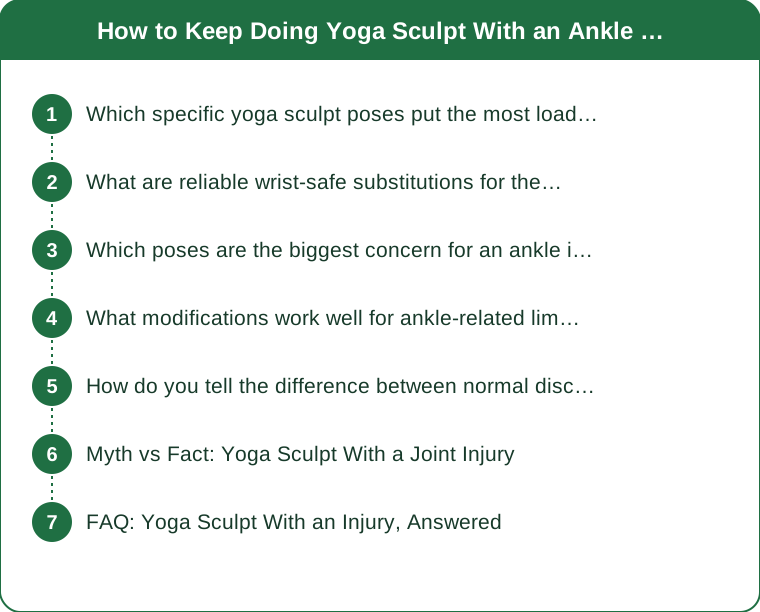
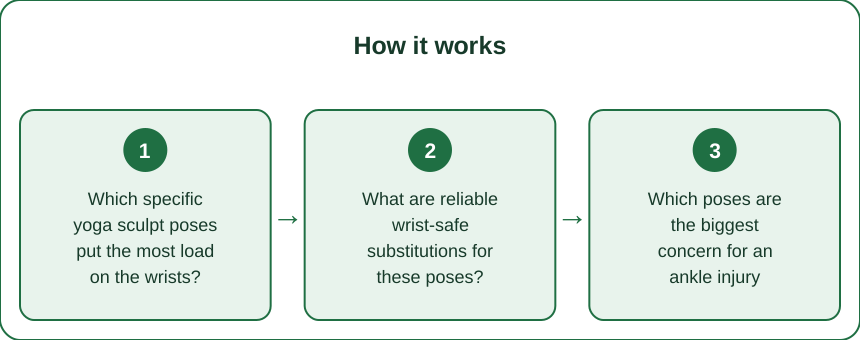
Which specific yoga sculpt poses put the most load on the wrists?
Plank, chaturanga, and any weighted movement performed in a tabletop or plank position put the most direct, sustained load on the wrists, since they require full body weight (often plus added dumbbells) to pass through a fully extended wrist joint. Downward dog also loads the wrist, though generally less intensely than active plank holds or push-up-style movements.
What are reliable wrist-safe substitutions for these poses?
Dropping to forearms for plank and chaturanga variations removes direct wrist loading almost entirely while preserving most of the core and shoulder engagement. For downward dog, a modified version resting on forearms (dolphin pose) achieves a similar stretch and strength benefit without wrist extension. Weighted arm exercises can often be done seated or standing rather than in a wrist-bearing floor position.
Which poses are the biggest concern for an ankle injury specifically?
Single-leg balance poses, jump-based cardio bursts, and deep lunges with significant ankle flexion put the most strain on an already-vulnerable ankle, since they require both stability and a meaningful range of motion at the joint simultaneously. Fast direction changes during cardio intervals are also a common aggravation point.

What modifications work well for ankle-related limitations?
Widening your stance for balance poses and holding onto a wall or chair for support reduces the ankle stabilization demand significantly. Replacing jump-based cardio bursts with low-impact steps or marching in place keeps heart rate elevated similarly without the landing impact. For lunges, a shorter stance with less ankle flexion reduces strain while still working the same muscle groups.
How do you tell the difference between normal discomfort and a sign to stop entirely?
Mild, general muscle fatigue or a stretch sensation is generally fine to work through with modification, but sharp, localized pain at the injury site, increasing swelling during or after class, or any instability that makes you feel unsafe are all clear stop signals. The general rule used in most injury-modified training: discomfort that stays roughly the same or improves during a set is usually acceptable; pain that sharpens or worsens is not.
Myth vs Fact: Yoga Sculpt With a Joint Injury
Myth: Any joint injury means skipping the entire class. Fact: most classes only heavily load a given joint during specific poses, which can usually be swapped rather than requiring you to sit out entirely.
Myth: Modified versions of poses don’t provide meaningful benefit. Fact: forearm-based and wider-stance modifications still engage most of the same muscle groups, just with reduced joint-specific load.
Myth: Pushing through mild pain builds tolerance for a recovering joint. Fact: pain (as opposed to general fatigue) during recovery is generally a sign to back off further, not evidence of building resilience.
FAQ: Yoga Sculpt With an Injury, Answered
Should I tell the instructor about my injury before class?
Yes — most instructors can suggest real-time modifications during class if they know in advance, which is far more useful than guessing modifications alone mid-flow.
Is it better to skip weighted portions entirely with a wrist injury, or just modify hand position?
Modifying hand position (forearms instead of palms) is usually enough for most weighted floor work; skipping entirely is only necessary if forearm-based versions still cause pain.
When is it safe to return to full, unmodified yoga sculpt after a wrist or ankle injury?
This depends heavily on injury severity and healing progress, so it’s worth checking with a doctor or physical therapist rather than timing it by feel alone, especially after anything beyond very mild strain.
This is general information, not medical advice — get clearance from a healthcare professional before training around an injury.
TL;DR:
- Plank, chaturanga, and weighted floor work load the wrists most; forearm-based versions remove most of that load
- Single-leg balance poses and jump-based cardio load the ankles most; wider stances and low-impact substitutions help
- Discomfort that stays steady or eases is generally fine; sharp or worsening pain is a hard stop
- Telling your instructor in advance lets them offer real-time modification cues during the actual class
A single vulnerable joint rarely means the whole workout is off-limits — it usually just means a handful of specific poses need a smart swap.
See It in Motion
Seen here: UPF 50+ Short Sleeve Rashguard Swim Shirt — shop it on bubblelime.com
Keep Reading
This article is for general informational and styling purposes only. Fit, sizing, and product availability may vary.